Abdu’l-Baha: Indigenous Americans are wild savage animals who lack reason…

The most preached and most celebrated teaching of Baha’u’llah is the Oneness of Humanity. In this article we will show using quotes from Abdu’l-Baha how the Oneness of Humanity applies to the Indians of America.

The original Farsi speeches of Abdu’l-Baha which were uttered in America were published by the Iranian National Institute for Baha’i Publications in the Second volume of the book Khatabat (speeches) in the year 127 Badi`. The book can be found on the official Baha’i library at:

http://reference.bahai.org/fa/t/ab/

and can be downloaded using the following links:

http://reference.bahai.org/download/ka2-fa-pdf.zip

http://reference.bahai.org/download/ka2-fa-doc.zip

On pages 112-113 Abdu’l-Baha is cited as uttering the following statements:

Abdu’l-Baha and native Americans
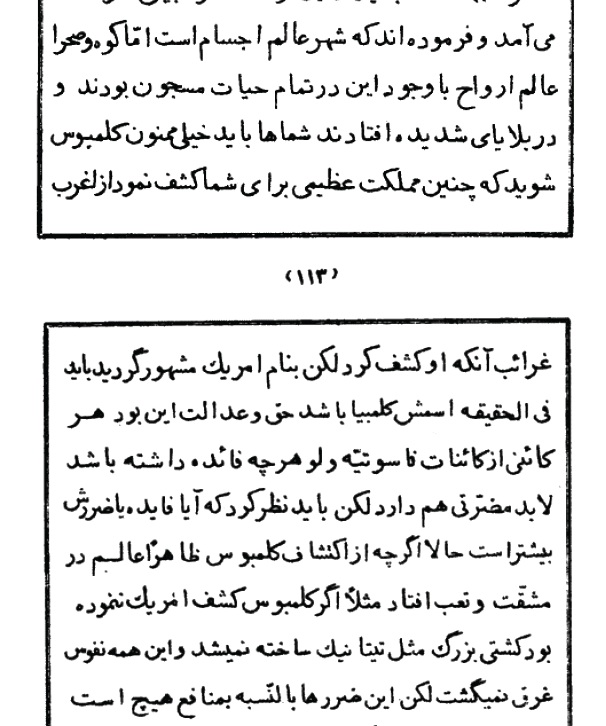
khatabat 2 112-113

“You must be very thankful to Columbus for discovering such a great country for you. It is the most strange thing that he discovered it but it became known as America. In reality, it must be called Columbus and this would be right and just.”

Read more of this post

Shaykh Ahmad Ahsa’i and the Penis Tree

Shaykh Ahmad al-Ahsa’i was regarded a heretic by some Shia scholars. Baha’is try to portray him as one of the forerunners to the Bab and Baha’u’llah who was hated by the Shia clergy because of his connections with the Babi and Baha’i creeds that they claim were prophesized in his writings. He is held with great respect and esteem by Baha’i figures and their followers and is praised greatly in Baha’i literature.

When one reads through the books of Shaykh Ahmad, it becomes evident why he was labeled as a heretic and rejected. Although he was a originally a Shia scholar himself and abided by Shia scripture, he later deviated and started uttering statements that even though were sometimes based on accepted Shia literature, were many times based on his own personal beliefs.

In this article we will translate a section of his book Jawami` al-kalim.

Read more of this post

Twelve Bahai Principles – An Introduction

The most important technique Bahais use to establish the superiority of their beliefs over others, are a series of slogans and statements called the “Bahai Principles” which they prorogate with great pride. Here is an independent view of the same.

 A new article will be uploaded every Thursday(Next article on 8 May) 

The Bahai Faith finds its origins in the Babi Faith propogated by Mirza Ali Mohammed Shirazi in Persia (modern day Iran). Starting with a claim to be the Bab or Gate of the hidden Imam Mahdi (as), the Bab slowly expanded his scope to claim to be the Mahdi himself and subsequently even made a claim of being God (Read More). Incidentally, the Bab never claimed to be an independent prophet – this claim was made popular by the Bahais to establish that the Bab brought a new religion.

Ali Mohammed Bab recanted several times from his claims – this is denied by the Bahais, but the proofs against them are overwhelming. There are atleast 4 recorded instances of his recantations (Read More).

Ali Mohammed Bab revealed a book called the Bayan, in two different languages (Arabic and Persian), both of which remained incomplete until his death. In this book, he gave his followers tidings about the appearance of ‘He whom God shall make manifest’ (man yuzhiruhullah) roughly 1,500 years after his death.

Read more of this post

Have you read these articles on BahaiAwareness.com?

Respected Readers,

Over the past couple of weeks, I have been busy with a lot of things so I did not get a chance to update BahaiAwareness.com as much as I would have liked. But with a help of Allah and through the efforts of some of my readers, I have put up several articles. Here they are. Please do go through them and let me know your feedback.

As always, these articles are backed by references and I hope my readers will appreciate that.

Finally, all praises are due to Allah, the Lord of the Worlds.

Tanbeeun Naemeen – Know Bahai Faith Through The Sister of Bahaullah 

The Beardless Man and the Bearded Woman 

UHJ or the House of Shoghi Effendi?

Bahai Organisation: Historical Perspective: Part I | Part II 

Finality of Prophethood: Prophet v/s Manifestation | Traditions | Companions | Scholars 

I do hope you will enjoy reading these articles.


Shoghi Effendi used charity money to go to Oxford – Ruth White

Taken from the book, The Bahai religion and its Enemy the Bahai Organization by Ruth White, the Tuttle Company, Rutland, Vermont 1929.

In PP. 201-206, Ruth White says: “In the Autumn of 1919 I sent to Abdul Baha [i.e. Sir Abbas Effendi] an American Express Company check of five hundred dollars and asked him to apply it to some of the many charities he was dispensing.

About four months after, we arrived in Haifa as the guests of Abdul Baha. On the day before departure I asked Abdul Baha if he had received the check. Without a moment’s hesitation and very emphatically he said that he had not received it. He repeated this a number of times, and seemed indignant that it had not been turned over to him. I discussed this with various members of the family of Abdul Baha, and one of the brothers-in-law said he would go to town and enquire about the matter.

He returned and said there were no record of the check. When I returned to America I asked the American Express Company to look up the receipt of the check I had sent through their office, and on the back of it was the signature of the person who had received the cash. This person was Shoghi Rabbani [i.e. Shoghi Effendi].

Read more of this post

Bahai Faith: Shundamentalism

One of the distinguishing doctrines of the Bahá’í Faith is its characterization of rebellion against religious authority, what it calls covenant breaking, as the most pernicious, contageous form of evil. Other religions have their outcasts and their devils, but there’s nothing out there quite like a covenant breaker.

Apostasy is the great spiritual crime of Islám. It was once considered a capital crime, and still is in some circles. The Bahá’í Faith uses its own definition for the term apostasy. The Bahá’í usage of the word implies that apostasy is equivalent to covenant breaking. It is not a capital crime, but is considered a highly contageous spiritual disease, and is therefore subject to severe shunning.

The doctrine of covenant breaking and the accompanying practice of shunning is traceable to Bahá’u’lláh and `Abdu’l-Bahá, but it was formalized by Shoghi Effendi:

Apostates, rebels, betrayers, heretics, had exerted their utmost endeavors, privily or openly, to sap the loyalty of the followers of that Faith, to split their ranks or assault their institutions.

God Passes By, page 408.

Read more of this post

Baha’i Faith : The Case of the Traveller, Part 3 of 3

Babism’s Background

“The founder of the Sheykhi school, with which in its origin the Babi movement is so closely connected, was Sheykh Ahmad of Ahsa (often, but apparently erroneously,written Lahsa) [1752-53-1826-27 AD]…he again visited Persia towards the end of his life, and that on this occasion he passed through Kazvin, where he paid a visit to HajiMulla Muhammad Taki.

The latter questioned him concerning his views on the resurrection, and, after a violent altercation, declared them to be heretical. In consequence of this many other divines, who had hitherto regarded Sheykh Ahmad almost as a saint, began to look askance at him or even to display open hostility…

The chief points wherein Sheykh Ahamd’s doctrine is regarded as heterodox are stated as follows. He believed that the body of man was compounded of parts derived from each of the nine heavens and the four elements; that the grosser elemental part perished irrevocably at death; and that only the more subtle celestial portion would appear at the resurrection…he believed himself to be under the special guidance of the Imams, especially, as it would appear, the Imam Ja’far-i-Sadik.

He regarded the Imams as creative forces, quoting in support of this view the expression~~~ ‘God, the Best of Creators,’ occurring in Kur’an xxiii, 14; ‘for,’ said he, ‘if God be the Best of Creators He cannot be the sole Creator.’ He also adduced in support of this view the tradition wherein the following words are attributed to ‘Ali:-~~~ ‘I am the Creator of the heavens and the earth’ He even went so far as to assert that in reciting the opening chapter of the Kur’an (~~~) the worshipper should fix his thoughts on ‘Ali as he repeats the words ~~~ ‘Thee do we worship’…Sheykh Ahmad Ahsa’i was succeeded at his death by his disciple Haji Seyyid Kazim of Resht [1793-94-1843-44]…

Read more of this post

Promised one of Islam and Bahai Faith

Article by Dr. Habib Siddiqui

Before I confront the Bahai view on the above subject, as presented by Babak Mohajerin, let me give a brief account of this religion how it started in order that Muslims have a fair understanding of what it stands for and why its understanding of certain explicit verses in the Qur’an are different than Muslims. (References are also cited for proof.)

In the middle of the 19th century, Mirza Ali Muhammad Shirazi, an Iranian claimed to be the agent and Bab (door) of the awaited Imam Mahdi. He had a small following, and the sect came to be known as Babieh (Babism). After a short while, he claimed himself to be the awaited Imam (1), and later as a prophet and the bringer of a new religion (2). He was not emotionally balanced, and as such, later claimed Godhood (3). In Resalah Lel-Thamarah (Treatise for fruit), he wrote:

”Truly I am certainly God: there is no God other than me. I am unique and single. Truly I am God, there is no God other than me – the eternal Lord, truly I am that very God and there is no God other than me who is unique and single. In the name of God who prevents and who is holy and pure, in praise of You my God, truly I call You and and all things to witness that You are truly God and there is no God other than You.”

Read more of this post

The Bahai Faith and Al Qaeda

“John Ricardo I. “Juan” Cole (born October 1952) is an American scholar, public intellectual, and historian of the modern Middle East and South Asia. He is Richard P. Mitchell Collegiate Professor of History at the University of Michigan. As a commentator on Middle Eastern affairs, he has appeared in print and on television, and testified before the United States Senate.

Cole became a member of the Bahá’í Faith in 1972 as an undergraduate at Northwestern, and the religion later became a focus of his academic research. He resigned from the faith in 1996 after disputes with Bahá’í leadership concerning the Bahá’í system of administration.”

qaedaThe Baha’i faith stands for universal love, for tolerance, and for a separation of religion and state.  The need for religious leaders to let politicians do the ruling is a key value stated over and over again in Baha’i scripture.

Unfortunately, a weird Baha’i sub-cult has arisen.  It structurally resembles al-Qaeda, and differs from al-Qaeda only with regard to methods, not ideals.  It does not usually employ violence or terrorism (though persons with this mindset have beaten up friends of mind).

And, most frighteningly of all, it has taken over and subverted the main institutions of the Baha’i faith.
Read more of this post

Youth Moral Classes = Young girls for trafficking?

Hi all,

…I’m a “white” woman in her 60’s who joined the bahai organization in the 70’s. I was attracted to the principals, especially the oneness of humanity. I was married to a Native American in ND with four children. In the years following I remained a steadfast bahai until recent years when I noticed the organization becoming more and more “top heavy”, with the leadership not listening to rank and file bahais, only sending directives from the top down. And while many of the directives quoted the bahai writings, in actuality the activities seemed to not reflect what a deepened bahai could believe. In my opinion Ruhi was created as top-down extracts from bahai writings with the goal of bringing in troops of people to brainwash, creating McBahais. An individual being deepened in the bahai writings seemingly became a liability to the leadership who more and more were manufactured from the Ruhi factory.

Pakistani Baha'i Community in Swimming Pool

Pakistani Baha’i Community in Swimming Pool

Read more of this post